
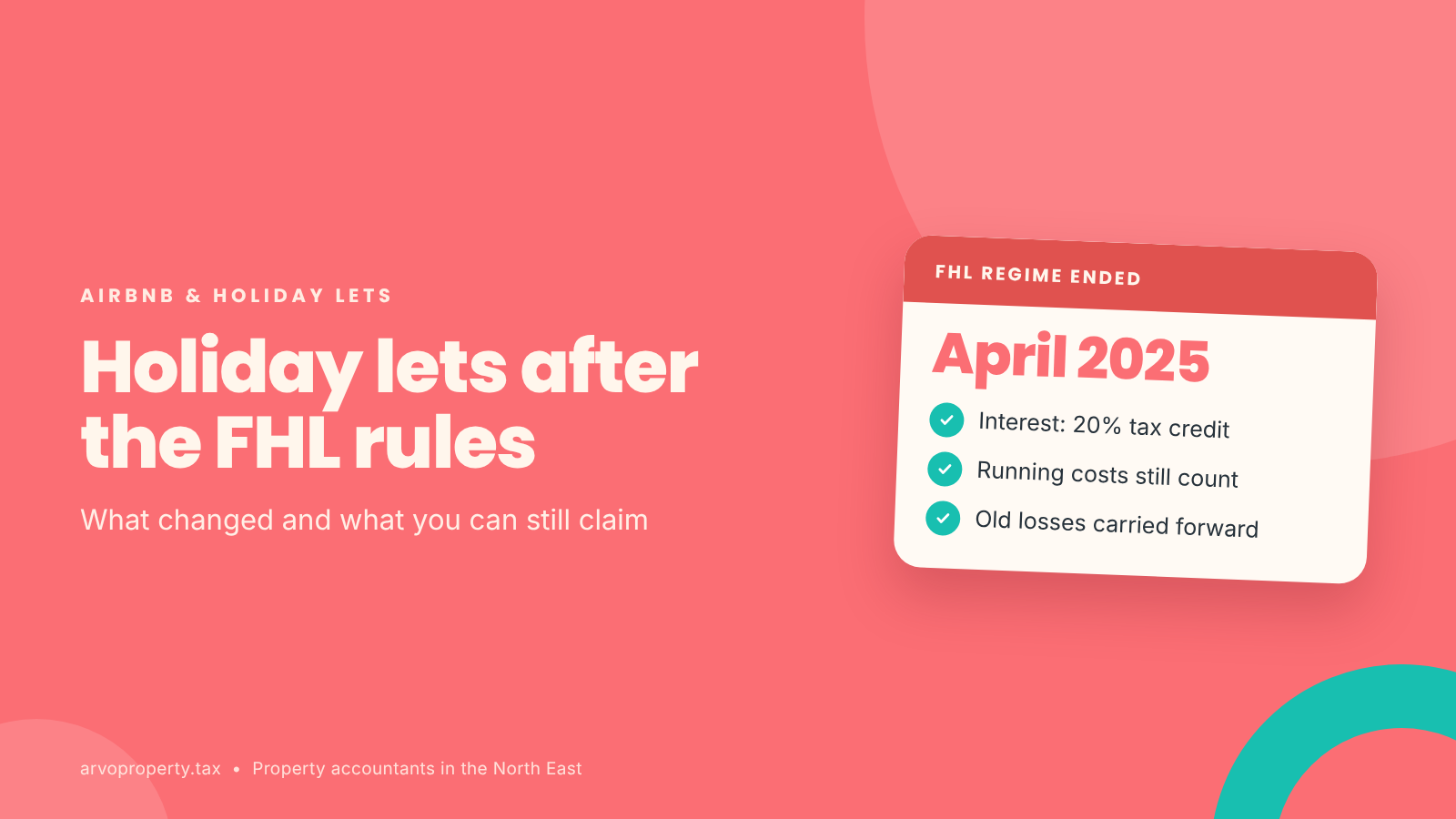
Until April 2025, furnished holiday lets (FHLs) had their own, more generous tax regime. It was abolished from 6 April 2025 for income tax and capital gains tax (1 April 2025 for companies). If you let a holiday cottage, an Airbnb flat or a lodge, this is what it means for you.
What hosts lost
Full relief for mortgage interest. Finance costs now get a tax credit at 20%, like other residential lets.
Capital allowances on new furniture, fixtures and equipment. You can still claim replacement of domestic items relief when you replace items like for like.
Profits counting as earnings for pension contributions.
Business capital gains reliefs, such as Business Asset Disposal Relief, rollover relief and gift relief.
The freedom for couples to split profits however they chose. Jointly owned holiday lets are now taxed in line with ownership, like other property.
What still works
Normal running costs are still deductible: cleaning, laundry, platform fees, utilities, insurance, repairs and advertising.
Capital allowance pools built up before April 2025 can continue to be written down.
Unused FHL losses can be carried forward against your wider property profits.
Rent-a-room relief still covers up to £7,500 a year if you let a furnished room in your own home.
Other things to watch
VAT: holiday accommodation is standard-rated, and you must register if your turnover goes over £90,000 in any rolling 12 months.
Business rates or council tax: in England, a holiday let must be available for 140 days and actually let for 70 days a year to be assessed for business rates rather than council tax.
Making Tax Digital: holiday let income counts towards the MTD thresholds of £50,000 from April 2026, £30,000 from April 2027 and £20,000 from April 2028.
Should you change your setup?
For some hosts, the changes make a limited company, a change of ownership between partners, or even a switch to longer lets worth considering. Each option has costs, so run the numbers first. Book a free call and we will look at yours.